Welcome to Shepherd's Stream
Company
 Here is a list of frequently asked questions. If you don't see your question here then please send an email to support@shepherdsstream.com. We will do our best to answer your question. Thank you.
Extend the Reach of Your Pulpit
Sermon Stream is a comprehensive audio and video ecosystem provided by Shepherd’s Stream. Built specifically for church leadership, our platform removes the technical and financial barriers to broadcasting the Word of God. As a nonprofit ministry, we provide unlimited hosting and unlimited streaming at no cost to your church. Our platform provides a secure, censorship-free sanctuary for your leadership communication and media.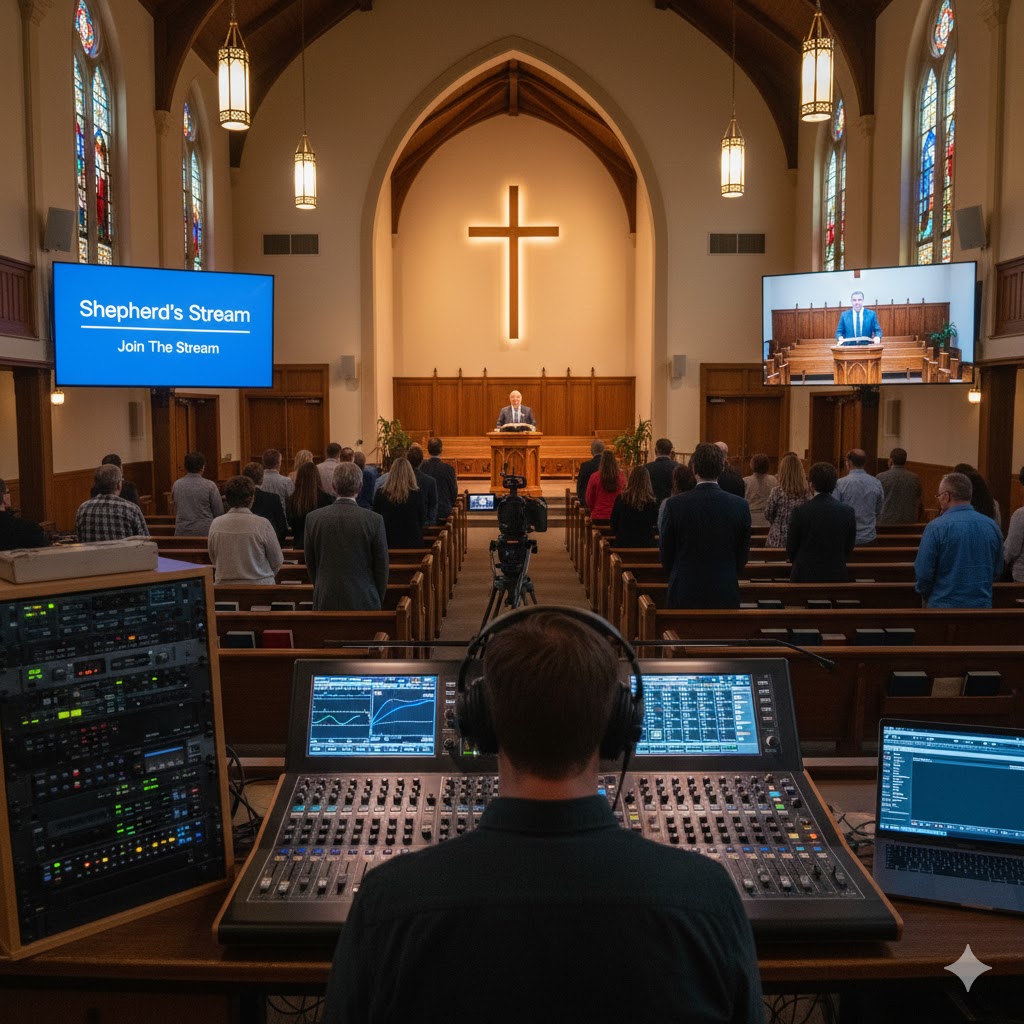
Real-Time Connection with WebRTC Technology
Most streaming services (like YouTube or Facebook) have a "lag" or delay of 20 to 30 seconds. We use the latest WebRTC (Web Real-Time Communication) technology to solve this problem.
-
Ultra-Low Latency: Experience near-instantaneous streaming. When you speak, your congregation hears you in real-time.
-
No Extra Apps Required: WebRTC works natively in all modern browsers. Your members can watch on any device without downloading special "plugins."
Everything You Need to Manage Your Sermon Library
You don't need to be a technical expert to manage a professional digital archive. Our tools are designed to handle the heavy lifting for you:
- The Sermon Manager: Upload and manage your library with ease. Use our Bulk Uploader to migrate years of ministry archives in minutes, and utilize integrated Transcription tools to make your sermons searchable for your congregation.
- Intelligent Series Manager: Group teachings by book, topic, or speaker. Our system automatically organizes your content into a clean, navigable archive for your members.
- One-Click Archiving: Monitor your live stream in real-time through our integrated dashboard. Once your service concludes, you can convert the live broadcast into a permanent sermon entry with a single click.
Professional Production with OBS Integration
For churches seeking a multi-camera, professional broadcast look, Sermon Stream is fully compatible with Open Broadcaster Software (OBS). Think of OBS as a "Digital Soundboard" for your video. By using the "OBS Virtual Camera" as your video input in our dashboard, you combine the production power of OBS (overlays, lyrics, and scene transitions) with the lightning-fast delivery of WebRTC. We are always available to help your team master this professional setup.
 If your church is listed in the Shepherd's Stream directory with incorrect information and you would like us to correct it please send an email to listings@shepherdsstream.com with the subject heading Listing Correction Request. Please include the following information listed below. Shepherd's Stream will verify the request and correct the listing.
-
- Name of Church
- Denomination
- Church Phone Number*
- Website
- Name of contact person at the church
- Full Address
If your church is not listed on Shepherd's Stream and you would like to have it added to our directory please go to New Church Listing. All new listing requests are subject to approval.
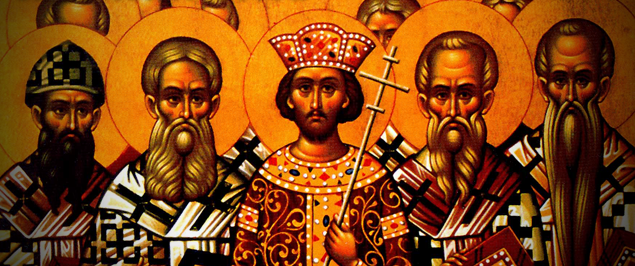 Baptist Church-The Baptist church is currently the fifth largest church in the world with over 40 million members in nearly every country in the world. 1 in 6 people in America are Baptist, with are over 75 Baptist associations, conferences, conventions, fellowships, groups, and unions each built upon the foundational tenet that Jesus Christ is Lord and Savior and the ultimate authority for Christians is the divinely inspired word of God, the Holy Bible. The Baptist church has its roots in the Puritan separatist movement of the early 17th century that also gave birth to such groups as the Presbyterians, Congregationalists, and Quakers. One defining principle of Baptists is their belief in full immersion baptism, where a believer plunges his entire body in water, symbolizing the resurrection to life anew in Christ. Shepherd's Stream strives to provide an up-to-date, inclusive, and comprehensive directory of all Baptist organizations, including subdivisions, affiliations, conferences, fellowships, and churches.
Community Church-Churches in the category of Community Churches span a wide range of beliefs, all uniting in their love for and service to God. In the early 1800s, the United States enjoyed a strongly rural character rich with small, close-knit communities. This remoteness more often than not extended to the churches that formed in these towns and enclaves, prompting Christians of different denominations to join together and form a single church to serve their community. These were the roots of the ecumenical movement in the U.S. that blossomed in the early 1900’s and continues to grow today, extending worldwide. The central theme of the International Council of Community Churches (www.icccnow.org), is to promote ecumenism via a multi-religious, multi-cultural, all-inclusive approach.
Episcopalian Church-The Episcopal Church began as the Church of England with roots dating back as far as 597 AD when St. Augustine of Canterbury brought his mission to England. The Episcopal Church in the U.S. is the Church of England in America, or the church of the Anglican Communion, first taking root in Jamestown, Virginia, in 1607. According to www.episcopalchurch.org, central to Episcopalian belief is that Jesus Christ is the Son of God, that the Bible is the inspired word of God, and that the Gospel should be shared in a manner harmonious with current culture, even while keeping inline with the teachings of Jesus Christ. Sacraments observed by the Episcopal Church are baptism, Eucharist, confirmation, penance, marriage, holy orders, and unction.
Holiness Church-The holiness movement emerged in the mid-1800s in the United States among Protestant churches and more specifically from the Methodist and Pentacostal churches. The movement grew more rapidly in the rural South and Midwest, where more conservative and traditional values were deeply rooted in the culture. A distinguishing characteristic of holiness churches in general are the rejection of many forms of popular entertainment including dancing and popular music, and also greater adherence to the avoidance of common cultural indulgences such as consuming alcohol and smoking of any sort. The core beliefs of Holiness churches include the existence and infinite power of the Godhead: the Father, Son, and the Holy Ghost; that the Bible, the Holy Scriptures, is the Word of God; that the carrying out the Great Commission should be the object of dedication for every believer in the Lord Jesus Christ. Shepherd's Stream has strived to include a large and comprehensive directory of churches and organizations that fall under the Holiness Church umbrella, including among others, the Church of the Nazarene and the Salvation Army.
Lutheran Church- The Lutheran faith finds its origins in the teachings of Martin Luther during the early 16th century whose central thesis was that repentance was to be sought by believers, as God intended, and salvation was found not by deeds, but by faith alone. Luther began developing his views as a response to what he saw at the time as a reckless and corrupt religion, Roman Catholicism. His 95 Theses became the foundation of the Protestant Reformation and by the year 2000, there was estimated to be more than 65 million Lutherans worldwide. In the United States, the Lutheran Church is represented by three major branches. In order of most liberal to most conservative in its interpretation of the Scriptures, Evangelical Lutheran Church in America (ELCA), the Lutheran Church - Missouri Synod(LCMS), and the Church of the Lutheran Confession (CLC). You may find a comprehensive listing of all churches that compose these three branches, and many more smaller Lutheran organizations and churches, as well, on Shepherd's Stream.
Mennonite Church- The creation of the Mennonite Church is credited to Menno Simons, a Dutch priest and subsequent leading pioneer of the anabaptist movement in Europe in the early 16th century. Specifically, the Anabaptist group that was given the name, “Mennonites”, by their critics was formed on January 21st, 1525. Largely because of the Anabaptist belief in re-baptism, or adult baptism, the adherents to this practice were labeled heretics and endured vicious persecution for over a century. King Ferdinand I, in fact, appointed a commission to mobilize groups to “hunt” Anabaptists, know as “Täuferjäger”. The faith grew rapidly regardless, and along with the Hutterite and Amish, Mennonite communities can be found in nearly every state in America, as well as Asia, Africa, Latin America, and Europe. Mennonites believe that Jesus is the Son of God and in eternal salvation in Heaven. Core practices are avoidance of secular activity such as military service and holding public office, Christ-centered missionary work, and baptism solely to followers of Christ and those who practice His teachings. The seven priorities of the Mennonite Church, as listed on www.mennoniteusa.org, are Christian formation, community and witness, stewardship, leadership development, intercultural transformation, and inter-church relationships.
Pentecostal Church- Pentecostal Church membership is one of the largest among Christians in the United States. Pentecostalism is based on the early Christian event of the baptism of the twelve disciples by the Holy Spirit on the day of Pentacost. Most often credited with the proliferation of the movement in the U.S. is the 1906 Azusa Street revival that took place at the Apostolic Faith Gospel Mission in Los Angeles, where Pastor William Seymour, among others, led hundreds - as many as 1,500 per day - of attendees in hours-long prayer and weeks-long preaching that lasted continually for about three years. The sustained, rigorous experience led attendees to share in what they deemed as the Holy Spirit moving through each and every person at the event, prompting many to engage in glossolalia, or speaking in tongues. Pentecostalism grew rapidly in the United States in the early 20th century, giving rise to the charismatic movement of the 1960s, where gifts of the Spirit are emphasized. Pentacostals believe the Holy Scriptures are the inspired Word of God and in the existence of the Godhead - the Father, Son, and the Holy Ghost. Scripture is interpreted literally and adult baptism is a central rite.
Presbyterian Church- Presbyterianism is a mainstream Christian denomination, the roots of which lie in the Protestant Reformation of the 16th century and the reformed theology of John Calvin. Approximately 2.5 million Christians belong to the Presbyterian Church in the United States. Presbyterians believe in a man’s salvation through Jesus Christ as a gift from God and not by man’s accomplishments. Church governance is a distinguishing characteristic of the Church. (Note the word, presbytery, a governing body derived from the Latin and Greek words for elder.) Both men and women are included in church governance and, with pastors and elders given broad powers of discretion.
United Church of Christ- The United Church of Christ was formed by the union of the General Council of Congregational Christian Churches and the Evangelical and Reformed Church in a General Synod on June 25, 1957. Although the UCC is a mainline Protestant Christian denomination with roots stemming from the Reformed, Evangelical Protestant, and Congregational churches, a hallmark of the United Church of Christ is the organization’s commitment to the independence of its member churches with respect to doctrine, ministry, theology, and morality. Per www.ucc.org, “The UCC has no rigid formulation of doctrine or attachment to creeds or structures. Its overarching creed is love.
United Methodist Church- The mission of The United Methodist Church, according to www.umc.org, is to make disciples of Jesus Christ for the transformation of the world. The United Methodist Church was formed in 1968 in Dallas, Texas, as a union between The Evangelical United Brethren Church and The Methodist Church, and has its roots in Methodism. With a membership size estimated at over 14 million in the United States, United Methodism is counted as the third largest Christian denomination in America, although in recent years its largest growth has been seen in Asia and Africa. The Church practices two sacraments, baptism and participation in the Lord’s Supper, with baptism being seen as the beginning of a discipleship of Jesus Christ.
These are the truths that Shepherd's Stream affirms.
 God is a Spirit, infinite, eternal, and unchangeable, in His being, wisdom, power, holiness, justice, goodness and truth; incomparable in all that He is; one God but three persons, the Father, the Son, and the Holy Spirit, our Creator, Redeemer, and our Sanctifier; in whose power, wisdom, righteousness, goodness, and truth we may safely put our trust.
We believe that the heavens and the earth, and all that in them is, are the works of God's hands; and that all that He has made He directs and governs in all their actions, so that they fulfill the end for which they were created, and we who trust in Him shall not be put to shame, but may rest securely in the protection of His almighty love.
We believe that our one aim in life and death should be to glorify God and enjoy Him forever; and that God teaches us how to glorify and enjoy Him in His inerrant Word, that is, the Bible, which He has given by the infallible inspiration of His Holy Spirit in order that we may certainly know what we are to believe concerning Him and what duty He requires of us.
We believe that God has established His Church in the world, one and the same in all ages, and now, under the Gospel, has endowed it with the ministry of the Word and the holy ordinances of Baptism, the Lord's Supper and prayer; in order that through these means, the riches of His grace in the gospel may be known to the world, and by the blessing of Christ and the working of His Spirit in them that by faith receive them, the benefits of redemption may be communicated to His people; wherefore also it is required of us that we attend on these means of grace with diligence, preparation, and prayer, so that through them we may be instructed and strengthened in faith, and in holiness of life and in love; and that we use by best endeavors to carry this gospel and convey these means of grace to the whole world.
We believe that as Jesus Christ has once come in grace, so also is He to come a second time in glory, to judge the world in righteousness and assign to each his eternal reward; the wicked shall have the fearful but just sentence of condemnation pronounced against them, wherein their consciences shall fully concur, and they shall be cast into hell, to be punished with unspeakable torments, both in body and soul, with the devil and his angels forever. The righteous in Christ shall be caught up with Christ and there openly acknowledged and acquitted; shall be received into heaven, where they shall fully and forever be freed from all sin and misery; filled with inconceivable joys, made perfectly holy and happy in both body and soul, in the great company of all God's saints and holy angels, but especially in the immediate vision of God the Father, of our Lord Jesus Christ, and of the Holy Spirit, to all eternity.